
Z/1383 (Sometimes Z/1333) Signaller Royal Navy Volunteer Reserve
Pursey had a brief life but he filled it with dedication and determination to serve his community and his country.
Pursey Short was born in Taunton on the 23rd of September 1894, the second son of Frederick William Short and Mary Jane nee Pursey. As a child Pursey lived with his parents and older brother William in South Street, and his father worked as a printer compositor. Pursey went to Taunton School, but had left by the time he was sixteen and started work in a cardboard box factory, probably the business called John Thomas & Co. at 2 Paul Street. The 1911 census shows Pursey living with his parents and William at 72 Alma Street, Taunton, and his nineteen year old cousin Arthur Tay was staying with them.
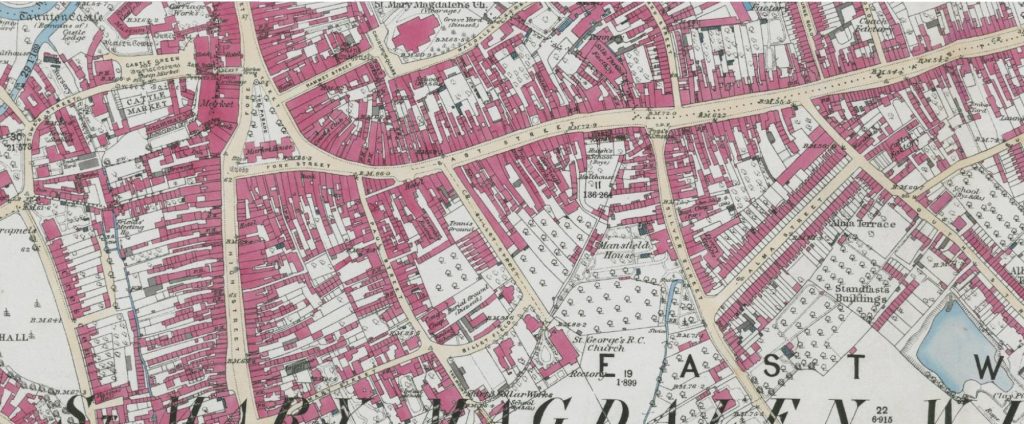
Sometime between 1911 and 1914, Pursey left home and moved in with his maiden aunts Caroline and Emma Pursey in Bridgwater[i]. Caroline Pursey worked for her brother in law William Masding, who was a director of the Tone Vale Manufacturing Company which made shirt collars, and this may be where Pursey also found work.
Sea Scouts
Pursey was very committed to the Boy Scouts and was awarded the Silver Wolf award, the highest scouting award given to an adult, for exceptional service[ii]. In Bridgwater he became Scoutmaster of the 4th Bridgwater Troop of Sea Scouts[iii]. The Sea Scouts were formed in 1903 and as well as the more usual scouting activities, they learnt to swim, row and sail. During WWI all Scouts assisted the armed forces as messengers and guarding bridges, and those on the coast took over coastal watch duties. They learnt how to identify different vessels, kept a regular lookout and noted and reported what they saw. They were under the control of the coastguard but were supervised by their patrol leaders.
When WWI started in 1914, Pursey was keen to volunteer and serve his country, but was rejected for foreign service because he didn’t meet the physical requirements. Undaunted, Pursey kept trying although he was rejected three or four more times. Eventually, Pursey was able to enlist in Bridgwater on the 13th of November 1915, at the same time as his cousin Stanley Henry Pursey Masding[iv]. His experience of leading a group of Sea Scouts on coastal watch must have helped convince the recruiters in Pursey’s favour.
R.N.V.R.
Pursey joined the Royal Naval Volunteer Reserve and became a signaller, Service number Z/1383. He was attached first to the shore establishment H.M.S. Pembroke I at Chatham, and then H.M.S. Victory I, another shore base at Portsmouth. His R.N.V.R service record shows that in 1915 he was 21 years old, 5 feet 3 inches tall, with light brown hair, blue eyes and a fair complexion. Pursey would have already learnt Morse code and semaphore flag signalling with the Scouts, and he would soon have become a useful signaller.
U-Boat campaign
From the start of the war in 1914, German U-Boats deployed in the Atlantic and the North Sea with the intention to sink merchant shipping and so starve Britain and her allies of supplies of food and munitions. At first the U-Boats followed ‘prize rules’, so they would surface and give the crew and passengers on the targeted vessel time to get off the ship. However, this left the U-Boats vulnerable to attack, and on the 4th of February 1915, Germany declared a war zone around Britain, and merchant ships were then attacked without warning[v].
S.S. Maine
As a member of the Royal Naval Volunteer Reserve, Pursey was serving as a signalman on the French registered steam ship S.S. Maine in November 1917. Built in 1906, this 774 ton merchant ship was operating between Newhaven and Dieppe to re-supply the front line.
On the 21st of November, the S.S. Maine was struck by a torpedo from the U-boat UB 56 and sank in the English Channel, 30 nautical miles (56 km) off Newhaven. All but one of the crew were lost with the ship, including Pursey Short.
Memorials
Pursey is remembered on the S.S. Maine War Memorial in Newhaven which lists the 29 crew members lost on that day, many of whom were French[vi].
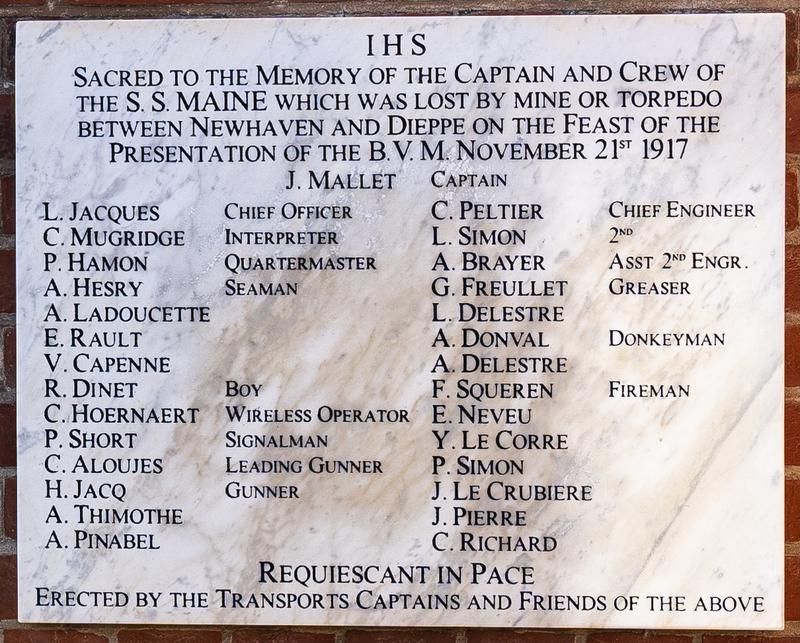
This memorial was originally positioned on a wall outside the Church of The Sacred Heart in Fort Road, Newhaven. However, this church is now closed and the memorial has been moved to the Newhaven Museum.
A similar memorial is on the West Jetty in Dieppe. The Dieppe memorial names the sole survivor as the boatswain Yves Lesne. The Dieppe Town Facebook page tells how M. Lesne recalled his terrifying ordeal.
“At 10:20 p.m., I was abruptly awakened by a terrible explosion. I jumped onto the deck. I saw no one and heard no cries. The entire stern of the ship is underwater. Fearing an explosion of cargo, I climb over the gunwale and jump into the sea. The instant I hit the water, a tremendous explosion, accompanied by an extremely powerful, illuminating flash, occurs, and the recoil sends me plummeting to a depth of at least ten meters. I resurface using my belt. I am alone amidst debris of planks and bundles of blankets.”[vii]
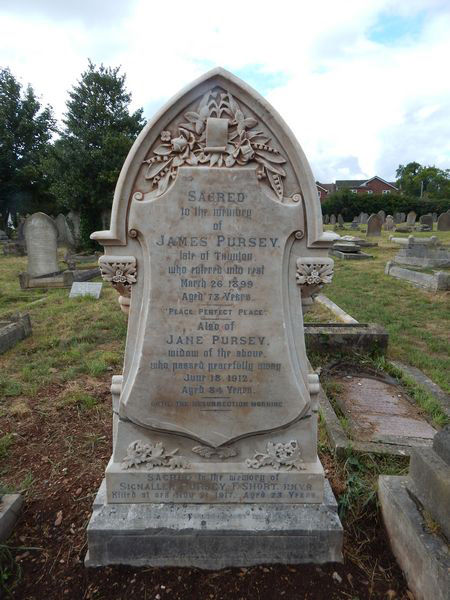
Pursey Short’s name also appears on the Naval Memorial at Plymouth, and his family remembered him on his grandparents’ headstone in Wembdon Road Cemetery. That inscription reads “Sacred to the memory of Signaller Pursey F. Short R.N.V.R. killed at sea Nov. 21st 1917 aged 23 years. His country’s call – not in vain.”
Other family members
Immediate family
1917 was a particularly difficult year as Pursey’s father Frederick had died in February 1917, ten months before his son.
The employers of Pursey’s brother William applied for an exemption for him, so William did not have to fight during WWI. He continued to live with his widowed mother Mary Jane until she died in 1921. Shortly after her death William married Ethel Massey, they didn’t have children.
Cousins
The two cousins mentioned above both served in WWI and survived.
Arthur Tay served in the Somerset Light Infantry as a Lance Corporal and then Colour Sergeant. He subsequently re-enlisted in WWII aged 49, joining the Auxiliary Military Pioneer Corps as a Second Lieutenant. He died in 1940 in Colchester while on active service, and has a War Grave in Clacton Cemetery, Essex. Arthur’s younger brother Ernest Tay also joined up during WWI, and served as a Sergeant in the Labour Corps. He survived the war, but in January 1928 he was found dead in the Thames in unexplained circumstances. He was 35 years old.
Stanley Masding joined The King’s (Liverpool) Regiment serving as a Second Lieutenant, then transferred to the Royal Air Force as a Lieutenant. He returned to Bridgwater after WWI to work in his father’s shirt collar business. In WWII Stanley became an Air Raid Precaution Sub Controller No. 4 Bridgwater Area. He married and had one son.
Miles Kerr-Peterson, Clare Spicer and Jill Trethewey, 30/04/2026
References
Ancestry.co.uk – births, marriages, deaths and military records, De Ruvigny’s Roll of Honour, county directories.
Friends of Wembdon Road Cemetery – obituaries
Imperial War Museum – war memorial images
Ville de Dieppe Facebook page
Our Newhaven.org.uk
British Newspaper Archive – digital images of the Taunton Courier and Devon and Somerset News
Blake Museum – index of the Bridgwater Mercury during WWI
[i] Bridgwater Mercury 28 Nov 1917
[ii] De Ruvigny’s Roll of Honour 1914-1919
[iii] Taunton Courier 24 Nov 1915
[iv] Taunton Courier 24 Nov 1915
[v] Imperial War Museum – The U-Boat campaign that almost broke Britain.
[vi] The SS Maine War Memorial was originally placed on a wall outside the Roman Catholic Church of the Sacred Heart in Fort Road, Newhaven. This church was no longer in use and the site is now being redeveloped. The memorial has been moved to the Newhaven Museum, Paradise Park, Newhaven, Lewes, East Sussex, BN9 0DH
https://www.iwm.org.uk/memorials/item/memorial/43465
[vii] Ville de Dieppe Facebook page https://www.facebook.com/villedieppe/photos/comm%C3%A9morations-un-d%C3%A9p%C3%B4t-de-gerbes-en-m%C3%A9moire-des-marins-du-ss-maine-le-21-novemb/877722614513547/?_rdr