
George Haysham (1854-1908) bricklayer and stonemason.
It is said that everyone has fifteen minutes of fame and for George Haysham this came in January 1881 on a bleak winter’s day. He responded to a desperate situation and showed himself to be a brave and resourceful man. In due course George was recognized for gallantry by the Mayor and magistrates of Bridgwater and the Royal Humane Society.
The Haysham family have lived in Bridgwater for at least three hundred years. The surname can be spelt in many different ways in the early records including Heysham, Hysam, Hyson and Aysham. With one or two exceptions, those buried in the Wembdon Road Cemetery were the descendants of George Haysham (1789-1881), a plasterer of West Street.
George Haysham the plasterer lived an exceptionally long, honest and hard-working life with his wife Mary and their five children. However, there was an occasion when he came to the attention of the magistrates. One Saturday night in November 1833 about 7pm, a man named Charles Burgess knocked on George’s door and demanded payment of an account. A dispute arose about the amount of the bill. George ordered him out of the house but Burgess wouldn’t leave. George shoved him out the door.
“I will knock your bloody head off,” swore Burgess.
“I’ll settle it with you,” replied George and punched Burgess so hard that for a moment he could barely stand. A few minutes later the fight continued in the street. Witnesses said Burgess was drunk but George was sober. George took Burgess to court for assault and was heard by the magistrates two days later. Twelve-year-old William Haysham testified in support of George, but the magistrates dismissed the case due to other conflicting accounts. It was out of character for George to behave that way. Only two weeks later George was standing in St Mary’s churchyard as they buried his wife Mary. It is quite likely that Mary was upstairs suffering her final illness and her husband was already fearing the worst when Burgess knocked.
George was left with three sons and two daughters, of whom the eldest, John, was fourteen and the youngest was still a baby. His sons all remained in Bridgwater: John became a shoemaker and the father of the younger George; William was a stonemason and plasterer; and Charles a bricklayer.
When John Haysham (1819-1877) the shoemaker finished his apprenticeship he worked for a time as a journeyman shoemaker in Ross, Herefordshire. He returned to Bridgwater in 1844 and married May Sharpe. They lived in Moat Lane and then in West Street, most likely over John’s workroom and shop. They had a family of nine, of whom five daughters and two sons survived childhood. George Haysham, bricklayer, was their fifth child and eldest son. The second son, William, also began his career as a bricklayer. John the shoemaker gave his widowed father a home and after John died, George the plasterer stayed on with the widow May Haysham and a granddaughter.
By 1881, the younger George Haysham and his brother William had both married and were starting families of their own in Hamp Street and Albert Street respectively. Three of the daughters were already married. John’s sons-in-law included a Royal Navy seaman who took his family to New Zealand, a bricklayer, a brick and tile yard worker and a carpenter.
On Thursday morning, January 13th, at about 9am, Thomas Maynard was at home in his cottage by Browne’s Pond at Hamp finishing his breakfast when he heard desperate cries for help. He raced outside and followed the cries to the pond where he saw a boy in a perilous position half in the water and clinging onto the broken ice.
“Remain quite still while I run to Mr Tamlin’s to fetch a ladder.” [i]
Browne’s Pond was originally a clay pit dug in the years around 1850 for John Browne’s brickworks at Hamp. By 1881 it was disused and flooded. Browne’s Buildings were the closest but Hamp Ward Cottages and the houses on Taunton Road were not far away.
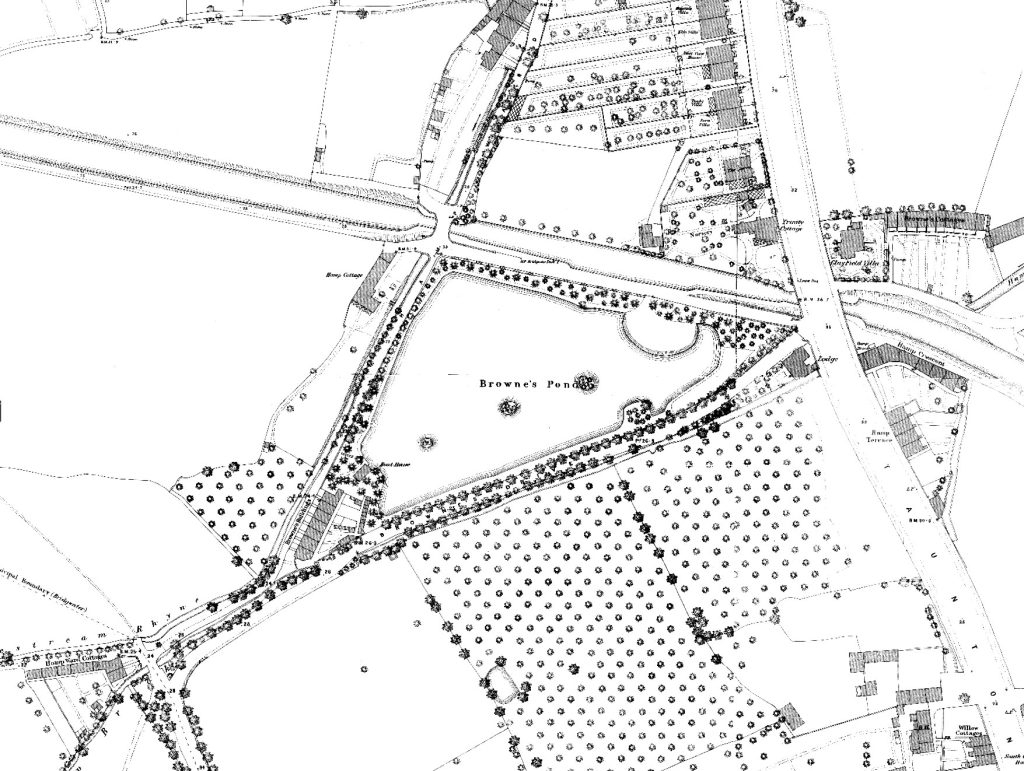
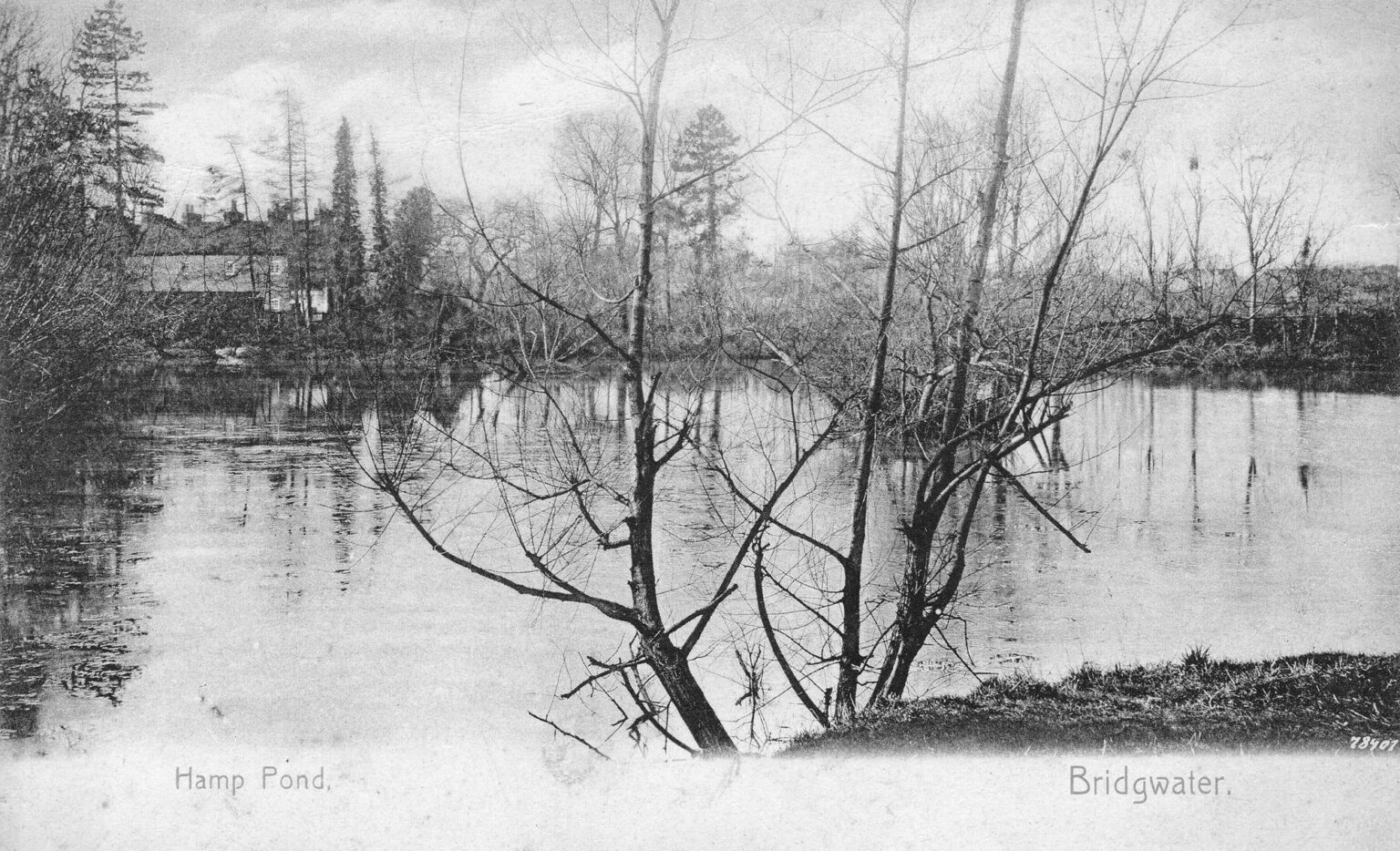
That morning George Haysham was also eating breakfast in his cottage nearby. Suddenly he heard banging on his front door and a woman shouting for him to come quickly. She had heard cries for help and discovered a boy had fallen through the ice on Browne’s Pond. Only his head and shoulders were visible. George knew the icy water could kill the boy in minutes if he fell in and despite being called a pond, the water was quite deep. George grabbed a length of rope and hurried the short distance to the pond. When he arrived he quickly summed up the situation. A group of boys aged in their early teens stood at the edge of the pond and he could see the boy who had fallen in. It was fifteen year old William Bovett, the son of Mr Edwin J. Bovett, the vet. One of the boys watching was William’s younger brother Albert. They told George they were skating near the bank, but William had ventured further out on the ice. He was nearly to the middle of the pond when the ice gave way under him. He fell into the water, but the hole in the ice was only just big enough for his body to pass through, and by stretching out his arms as he fell, he succeeded in resting his arms on the ice around him. He was wearing seal-skin gloves which probably saved his life as he could not possibly have retained his hold on the ice for so long otherwise.
George tied a broom to the rope and then, carrying the makeshift lifeline, carefully climbed down onto the ice and walked towards William. After passing what is known as the first island, he found the ice cracking around him. He kept going a little further and then threw the rope in the direction of William, but it was too short to reach him. At the moment George threw the rope, owing probably to the jerk and additional pressure of his feet occasioned by the exertion, the portion of ice on which he stood also gave away and the next instant he fell into the water and disappeared beneath the surface. He rose immediately through the hole and succeeded, with some difficulty, though he hardly knew how, in catching hold of the ice and climbing upon it again. Up to this time, no other adults had arrived on the scene. On looking around George saw William hadn’t moved. George couldn’t go any closer and he shouted to him,
“I can do no more to save you.”
“A thousand thanks for what you have done already, but do try,” replied William.
“I will, hold on!”
George retraced his steps, climbed safely ashore and ran to a neighbouring yard to get a ladder.
In the meantime, Thomas had found a ladder, brought it round by the lodge gate on Taunton Road and placed it on the ice.
William cried out, “I shall be frozen.”
“Stay a moment; let me pull off my coat as I cannot swim,” Thomas called back. He then sat on the ladder and pulled himself along with his hands on the ice which broke in several places and cut his legs. Thomas reached the first island where one of the other boys was waiting, but the ladder was too short to reach William.
Just in time George returned to the pond with another man, between them carrying a couple of planks and a second ladder, which was also pushed to the island, enabling the men to cross.
“George, who had fetched the second ladder with his wet clothes on, was with difficulty restrained by his wife, the owner of the pond, and other spectators from again venturing upon the ice.” [ii]
The two ladders were immediately lashed together and slid along the ice to William. He seized the ladder.
“Keep still a moment for me” called Thomas.
The ladder was tied to a stump on the island to prevent the ladder from tipping up with William’s weight, otherwise William would have been thrown into the water again. The rescuers then pulled the ladder by the rope to the island. They lifted William off the ladder onto the island and removed one of his skates. He was placed on a ladder brought by William Dyke, a burner in Hamp Brickyard, accompanied by Charles Manchip, foreman of the same yard.[iii] All four men, George, Thomas, Dyke and Manchip then pulled William back to land. [iv]
William had been in the water twenty minutes. It was surprising that he should have been able to hold onto the ice for so long. Rescuers and spectators alike feared every moment that he would “relinquish his grasp and disappear” before they could reach him. When William was brought to the bank he was “in a dreadful state of exhaustion and almost completely benumbed with the cold.” He was immediately driven by pony and trap to his father’s home in George Street, where his family rushed to help him inside and into warm, dry clothes. He was reportedly entirely recovered by midday. William grew up, qualified as a vet and practised in Bridgwater for over thirty years.[v]
George also suffered no ill-effects from his cold immersion and was praised for his gallant attempt at so much personal rest risk to rescue William.
“At the Borough Petty sessions on Monday the 14th inst., the Mayor presented to George Haysham, a bricklayer, the honorary testimonial of the Royal Humane Society, inscribed on vellum, for gallantry in attempting to rescue Edwin W. Bovett from drowning on a frozen pond at Hamp in connection with which he nearly lost his own life; also with a sovereign, the gift of the magistrates. The Mayor remarked that Haysham displayed conspicuous gallantry on the occasion, it being well known the water in the pond was of considerable depth and the ice very thin.” [vi]
It was a proud moment for George, his wife and daughters, his grandfather George the plasterer and the extended Haysham family. A sovereign was a gold coin with a value of one pound sterling. In addition, George had probably already been given a reward by the Bovett family.
The Royal Humane Society was founded in London in 1774 to prevent deaths from drowning. Life-saving equipment was provided for ports around the country and the bravery of those who risked their lives to save others was recognised. The Society depended on a friend or local official writing to recommend someone who had shown gallantry. The Society came to a decision and a few weeks or months later, the medal or testimonial was presented. According to newspaper reports, only thirteen awards were made by the Society for similar rescues or attempted rescues in Bridgwater between 1859 and 1914. Some others may have been missed by the papers, but even so it was a great honour.
Grandfather George Haysham plasterer died in July 1881 aged ninety-two and was buried in a family grave with his son Charles in the Anglican section of the Wembdon Road Cemetery.
George, the hero of Browne’s Pond, was married to Emily Martin. Between 1874 and 1894, Emily gave birth to fifteen children and none of those were twins. Six died in infancy, mostly in the few years after the Browne’s Pond rescue. At the same time, George’s younger brother William Haysham (1856-1923) had become a builder and contractor of Wembdon Road. He and his wife Lucy had eleven children. The two brothers and their wives broke with tradition and worshipped in either the Congregational or Methodist chapels, rather than attending the parish church. It was not unusual for people to attend different chapels according to whether they liked the sermons or perhaps proximity of the chapel to where they lived.
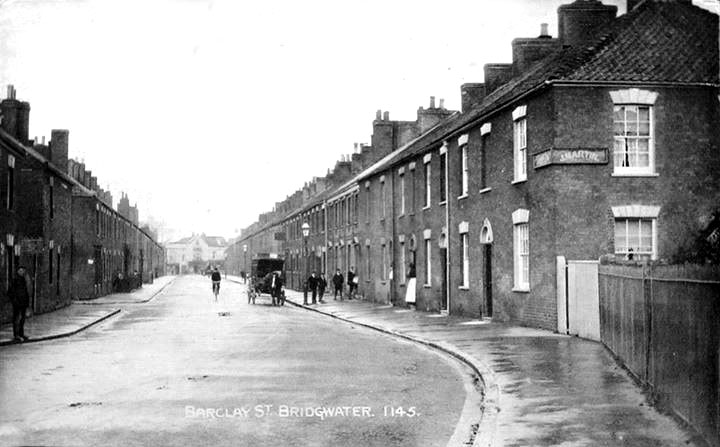
George Haysham held the licence of the Mariners’ Compass in St Mary’s Street in 1883 for several months. George returned to bricklaying and he and Emily and their children lived at various addresses in Bridgwater over the next twenty years. At the time of his death in 1908 George was a stone mason of Barclay Street. Emily died in 1917. George and Emily were buried in the Dissenter section of the Wembdon Road Cemetery, with at least five of their infant children. This is now an unmarked grave next to the north-most boundary of the cemetery, in Section 13, in a plot next to the Marchant memorial (23/1179).
The nine surviving children of George and Emily were all daughters. Most of them married and raised families in Bridgwater. They have every reason to be proud of George Haysham.
by Jillian Trethewey and Clare Spicer 7/2/2026
Sources
Bridgwater Heritage Group website. https://bridgwaterheritage.com/
British Newspaper Archive
[i] Thomas Maynard (born c1841) was born in Epping, Essex. He was a gardener living in Hamp with his wife and family. One of his daughters was born in “Oriental, South America” which was an old name for Uruguay. This suggests that Thomas had lived an adventurous life and William Bovett was lucky that such an able and brave man responded that day.
Charles Tamlin, born c1806, was a retired corn factor who lived four doors from George Haysham at Hamp.
[ii] Devon and Somerset News 27 January 1881 page 8 Bridgwater - The narrow escape from drowning.
[iii] William Dyke born c1833 lived two doors from Browne’s Buildings. He was a kiln burner for Hamp brick and tile works. Charles Manchip (c1846-1927) was a Bridgwater man who lived in Browne’s Buildings with his wife and three young children.
[iv] Devon and Somerset News 20 January 1881 Narrow escape from drowning. Gallant rescue.
[v] William’s brother Albert Bovett also became a vet but emigrated to America and drowned on a lake in Colorado when still a young man.
[vi] Western Gazette 18 March 1881 Bridgwater. Presentation for Bravery; Dorset County Chronicle 17 Mar 1881