

Frank West had a long career in the Post Office, but he also had a parallel career as a successful rugby club organiser and enthusiast. He was described as a ‘Somerset Rugby Stalwart’.
Frank had rather an unusual childhood, as his father lived separately from his wife and children. Frank’s father, William West, began his working life as a farm labourer in Rockbeare, a village east of Exeter in Devon. William married a Cornish girl called, appropriately, Mary Cornish, who came from a tiny hamlet near St Columb. William and Mary married in her home village in 1855, but by 1858 they were living in Woodbury Salterton in Devon and William had a new occupation.
Somehow William made the transition from being a farm worker to being an indoor servant for the Reverend Beauchamp Stannus and his wife the Honourable Mabella Geraldine Fitzgerald Vesey, eldest daughter of Lord Fitzgerald and Vesey.
The former parsonage is a large attractive house, dating from the times when Church of England ministers were often the younger sons of gentry. To work as an indoor servant for a family of some social standing, William West must have been able to show that he could present himself in a clean and tidy way, have good manners and be able to learn quickly. In 1861 he was described as a footman, the other servants were a coachman, a housemaid and a cook. While William was living in the Parsonage, his wife and two children were living in a cottage in the village, and Mary was working as a dressmaker.
Ten years later, Mary and her now six children were living in a cottage in Offwell, Wilmington, Devon. Mary was still working as a dressmaker, in spite of being on her own with the children and having a new baby. William was presumably visiting his family on his day off. He was now living and working in the Rectory in the nearby village of Widworthy, employed by the Rev. Marwood Tucker as a butler. Both the Tucker and Marwood families were landowners in the area.
Frank, their last child, was born in Offwell on the 5th of March 1872[i]. There was a parochial school in the village, which took a few free scholars each year, and there would have been a Sunday School associated with the church. Three of William West’s children – William junior, Bessie and Laura became school teachers, so they must have received a good level of education.
Frank starts work for the Post Office
Frank eventually became a clerk, so he also had received a reasonable standard of education, although he would have left school aged about 13 or 14. By the time he was 19, Frank had left home and was lodging in Honiton. He was working for the Post Office while studying to take the exams necessary to become a Sorting and Telegraphy Clerk. Frank would have had to get a certificate in Radiotelegraphy as well as pass exams in English, history, geography and arithmetic, while demonstrating ‘satisfactory handwriting’. When he passed the exams, Frank would then have had a probationary period before becoming an established Sorting Clerk and Telegraphist. Frank’s Post Office Superannuation Records show that he was engaged as a temporary sorting clerk and telegraphist on the 2nd of January 1892 for the wages of 18 shillings a week. He must have done his work very satisfactorily, as after only four months he became an established clerk, which gave him a pay scale of between 12 shillings and 40 shillings a week. After a brief spell working in Bournemouth, Frank had transferred to the Post Office in Bridgwater by 1894.

Sorting office
In 1894, the Bridgwater Post Office was situated in the High Street, Bridgwater. There were also two sub post offices, one in Eastover and one in North Street, but Frank would have been working in the sorting office in the High Street. The Post Office was open for business from 7 am to 9 pm on weekdays and the telegraph department was additionally open 8 am to 10 am on Sunday mornings. In the days before telephones were in widespread use, the mail was the main means of communication for business as well as pleasure. There were several mail deliveries a day both inward and outward, and the sorting office must have been a whirlwind of activity. All sorting was done by hand, and letters and parcels were sorted into baskets or pigeon holes for their onward destination. A more experienced sorting clerk might also be prepared to deal with ‘front desk’ duties such as selling stamps, postal orders and money orders. While the postmen and messenger boys wore a uniform, Frank wore his own clothes to work.
Telegraphist
In very large Post Offices, the telegraphists were separate from the sorting clerks, but in smaller, regional post offices, these two roles were combined, as in Frank’s case. A telegraphist would operate telegraphic transmitting and receiving equipment. The Post Office used a Morse code system for transmitting telegrams, but Frank might have been using a Wheatstone ABC Apparatus, a visual system which was designed to be used by operators with no knowledge of Morse code.

Wheatstone ABC apparatus, Post Office c. 1885 (Wikipedia)

This illustration shows post office telegraphists working in a very large central office, the Bridgwater office would have been smaller. Two clerks can be seen operating a Wheatstone ABC apparatus on the centre and left hand side. At the far left, a uniformed messenger boy is hurrying along, clutching a telegram form.
The Telegraph Act of 1885 limited the sixpenny telegram to 12 words, including the address, so the sender had to choose their words very carefully. Longer telegrams rapidly became expensive. Newspapers relied on the telegraph system transmit news reports quickly and received reduced rates when they used it in the evening. Stock brokers and racing bookies also made frequent use of this fast means of communication. These would transmit news of business opportunities, successes and failures, but the shipping industry also made very good use of the telegraph system. Lloyds had their own telegraphy stations at points around the UK coast and several abroad for international contacts, but these were connected to the main UK inland system via Post Office wires. The shipping news could indicate a sailor’s safety or loss at sea, and would be anxiously awaited by the families of mariners in Bridgwater.

The peak of telegraphic traffic was reached in 1900, with over 90 million messages sent in a year. After this the increasing use of telephones took business away from telegrams. At the end of 1908, the Post office issued a circular to its employees, instructing them in telephone manners, so as not to be ‘uncouth’. They must always remember to say ‘please’, and also ‘sorry’ if a caller was kept waiting[ii].
Bridgwater Post Office
In 1897 the Post Office wanted to enlarge the town centre site but the council wanted to charge a much higher rent for the use of the additional accommodation in the Market House building. The Post Office declined to pay this higher rent and bought a large house on Cornhill, formerly owned by Dr Parsons, with the intention of converting this property for use as a post office. By May 1897 the ground floor had been converted, and there was grumbling in the town that the premises were unsuitable and the façade too narrow to be given ‘an ornamental structure’ befitting to its central location[iii].
Only two months later the newly refurbished building was opened for public business on the 12th of July 1897. An article in the Bridgwater Mercury described how the main counter ran on the left hand side at right angles to the street, while on the right were partitioned desks for writing telegrams. The large room was well lit by a big arched window, at the top of which was a double sided clock which could be read from both inside and outside the building. After dark the room would be lit by incandescent gas burners in hammered iron brackets and pendants. Beyond the main room was a corridor, in which there was a lift. On the other side of the corridor was the postmaster’s room, which looked out onto the garden at the back. Steps lead down to the basement which was used for battery rooms[iv] and coal storage. Stone steps led to the upper floor where there was a large room for the telegraphy equipment, which was being connected up by the Royal Engineers. There was also the telephone switch room and a room for the messenger boys. On the floor above were ‘retiring rooms’ for male and female clerks (for the ladies were expected by and bye), equipped with stoves for cooking meals. There were also ‘separate and suitable’ sanitary arrangements. Mr Challow was the Postmaster[v].

Frank’s difficulty was that the old building in High Street was still used as a sorting office for a few years until the lease ran out, so his work was split between the two buildings. The foundation stone for the new sorting office was laid in May 1903, in the large garden at the back of the Cornhill office. It was expected to cost £5,000, and was completed by 1909[vi].
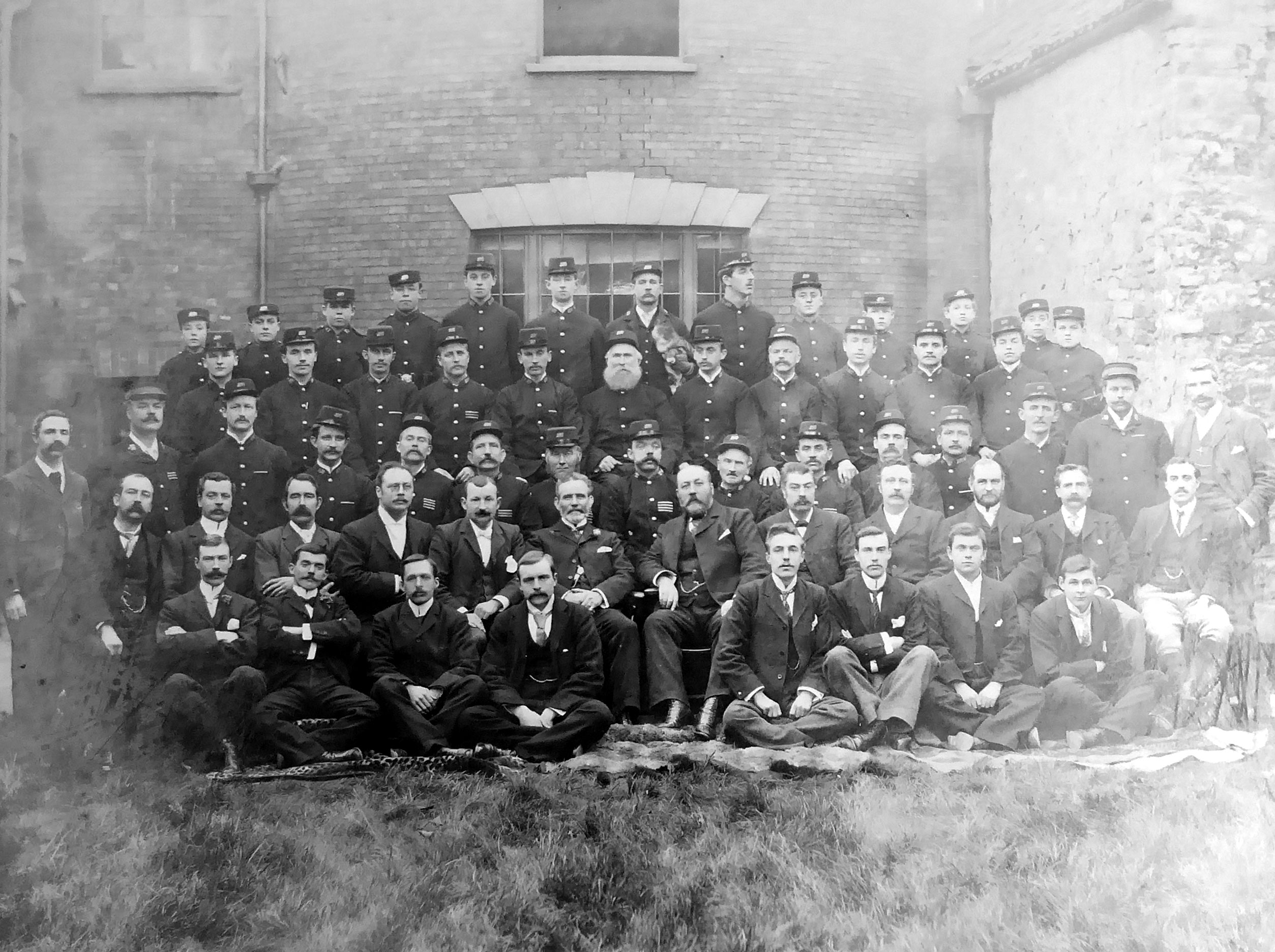
Frank was 42 at the start of the First World War and so was not called up. However, telegraphists were in demand for the armed forces and Frank would have had to cover the work of younger men who enlisted. During this war, the general public learnt to dread the knock on their door of the PO telegram messenger, since it so often brought terrible news. In fact the whole street would go silent at the approach of the telegram boy, as people waited to see which house he went to.
After the war, in 1919, Frank became a freemason, joining the Lodge of Perpetual Friendship. This would have given him a wider circle of friends, and also showed his commitment to his career.
Times change
Frank’s work would have changed with the increasingly widespread use of the telephone. This began to reduce significantly the use of telegrams. Telephone-telegram systems were introduced, where the telegrams were transmitted by telephone, a post office clerk would type out the message and it would then be hand delivered by a post office messenger.
On the 6th of March 1929, Frank was promoted to be an overseer. This meant that he became the supervisor for his section, and went from a weekly wage to an annual salary in the range of £180 to £220 a year.
Rugby in Bridgwater
As well as his day job, Frank gave much of his free time to his great passion – rugby. Frank started playing in the local club when he was working in Honiton. When he moved to Bridgwater, he became secretary of the Bridgwater Rugby Football Club. This was the earliest Bridgwater rugby club, first formed in 1875. The Bridgwater Albion Football Club was formed in 1891, and the two clubs were great rivals in the Somerset County League, playing against each other in Bridgwater in the cup final in 1910 at Easter. This home derby caused great excitement and very long queues for entry to the Malt Shovel Ground. The first match was a 3-3 draw, so the replay was a week later at the Albion’s Taunton Road ground. This time Albion won 13-0, and carried off the county cup[vii].

After the end of WWI, the first rugby match played in Bridgwater since the spring of 1914 was between the old rivals, Bridgwater and Taunton. This game was played at the Malt Shovel Ground at the end of February 1919. Both teams had to cobble together a side as former players were still wounded or missing, and men from both the Bridgwater RFC and the Bridgwater Albion RFC played together. Taunton had to play with one man short[viii]. Bridgwater won by 17 points to 3, but it must have been a very enjoyable occasion for all after the horrors of the previous five years.
The Bridgwater RFC and Bridgwater Albion RFC merged shortly afterwards, in April 1919[ix]. Initially this was to be just for one season under the name The Bridgwater Football Club, but the two merged clubs subsequently remained united under the new name of Bridgwater & Albion RFC. They were not the only clubs in the country to merge, so many men had been lost during WWI that this was a pragmatic decision. The newly merged committee expressed sympathy with the families of those players from both clubs who had made the supreme sacrifice during the war.
Somerset County Rugby Union
Frank West was elected to the Somerset County Rugby Union Committee in 1901, later holding posts as honorary treasurer, then secretary, and finally president in 1934. He started by being involved in the nitty gritty of selling tickets directly from his home, then went on to organise matches and other events[x].
“He was an experienced and capable organiser of county games, and the high reputation and success enjoyed by the Somerset Union for so many years was largely due to his efforts. He had an encyclopaedic knowledge of Rugby personalities and records, and was a recognised authority on the game for which he had done so much.” [xi]
In 1937, Frank used his position as Somerset County president to lobby the Rugby Football Union to resume international games with France. Frank’s opinion was that “If all Rugby Union players throughout the country voted there would be an overwhelming vote in favour of the resumption of the French games.” France had been ejected in 1931. WWII intervened and France was not welcomed back until 1947, which was too late for Frank.
Effie Blanche Edwards 1873 - 1947
By settling in Bridgwater, Frank had moved away from the rest of his family, and he met and married a local girl. Effie Blanche Edwards had also spent much of her childhood separated from her parents.
Effie was the daughter of Phillip Edwards and his wife Kate nee Cockings. Phillip Edwards was born in Truro, Cornwall, but he moved to Bridgwater to be apprenticed to Kate’s father William. William Cockings was a watch maker and engraver with a shop at 9 High Street, Bridgwater.
Kate Cockings married Phillip Edwards in St Mary’s, Bridgwater in 1865, and they set up their own watch making business in Burnham-on-Sea, where Effie was born in 1873. Perhaps the business didn’t prosper, or Phillip decided to try working in London, as by 1881 Phillip and Kate had moved to Camberwell in South London. However, they only took two of their four children with them, leaving the middle two, Otto and Effie, living with their uncle Spencer Cockings, who by now had inherited William’s watch making business in Bridgwater. Effie was only 7 years old and her brother Otto 9 years old, which was a lot for a bachelor like Spencer to take on, but he engaged a housekeeper to help.
By 1891, Otto had moved to London to live with his parents, but Effie, now aged 17 and working as a milliner’s apprentice, decided to stay in Bridgwater and live with a cousin, Catherine Towells, in St Mary Street. Effie met Frank West and they got married in St Mary’s Church on the 15th of August 1898. Effie’s elder brother Percy and her younger sister Elizabeth travelled down from London to be witnesses at the wedding.
The young couple set up home in 2 Blake Place (opposite St John’s Church) where they lived for the rest of their lives. They soon started a family, having Arthur in 1899, Muriel in 1901 and Otto in 1903. In 1911, Frank and Effie were at home in Blake Place, and Effie’s cousin Catherine Towells was living with them. Their 8 year old son Otto was not with his parents but was visiting the family of rope manufacturer Clifford Waddon in North Petherton. Clifford also had an 8 year old son called Raymond, so it is likely that Otto and Raymond were friends.
2 Blake Place
This comfortable semi-detached property remained the home of Frank and Effie West to the end of their lives, and afterwards became the home of their daughter Muriel and her husband Ernest Gregory.


Arthur West 1899 – 1917
Arthur was born on the 18th of April 1899, and baptised at St Mary’s Church on the 21st of May 1899. He was at home with his parents on the two censuses of 1901 and 1911. There was a boys’ school, St John’s Higher Elementary, very close by, which Arthur probably attended.
Arthur would have been two or three years into his first job as an accountant clerk when he fell ill with pneumonia. He was taken to the Bridgwater Infirmary where the treatment was good nursing care while his immune system fought the infection. He had weeks of fevers, chest pain and coughing. Without antibiotics, Arthur was unable to shake the very aggressive infection which lasted for two months. It had spread to the space between his lungs and chest wall, causing empyema. Arthur died in hospital on the 28th of March 1917, with his father beside him. He was 17 years old.
Arthur was buried in Wembdon Road Cemetery in Anglican Section A plot 24/58.

After this tragedy, Frank and Effie had to pick themselves up and carry on for the sake of their two younger children, Muriel and Otto. By 1921, both these two had left home to start on their adult lives. Muriel went to the Diocesan Teacher Training College in Salisbury. This college had received a very good HMI inspection report in 1905, saying that the teachers it sent out were hard working, high minded and intelligent. Muriel married accountant Ernest Gregory in Bridgwater in 1927, and after the wedding they lived in Wembdon Road.
Living in Bridgwater had encouraged Otto to turn to the sea for his career. In 1923 he gained his certificate of competency to be Second Mate for foreign going steam ships. He travelled widely as part of his work, so his parents would only have seen him when he had shore leave in the UK. Otto married Gwendolyn Edna Rainford in 1939 in Glebe, a suburb of Sydney, Australia, but Frank and Effie were probably not able to attend the wedding. Otto and Gwendolyn settled in Australia.
Retirement
Frank had three years to enjoy his promotion to overseer before he retired on the 5th of March 1932, aged 60. After working for the Post Office for 40 years and 2 months, Frank was awarded the Imperial Service Medal, which civil servants could be nominated for, on account of ‘long, zealous and meritorious service’. Of course, he also got a Post Office pension as well.


After retiring from the Post Office, Frank worked part time as an assistant at the Eastover branch of the Somerset and Wilts Trustee Savings Bank, and he certainly did not retire from rugby. He became president of the Somerset County Rugby Union in 1934, and was a familiar figure at all the chief rugby grounds in the county, not only organising matches and enjoying the game, but also helping to select players for the various club teams. One of Frank’s obituaries described him as ‘a Somerset Rugby stalwart’[xii].
Frank was still very active into his late sixties, but then after a short illness of seven weeks he died aged 69, on the 26th of November 1941. He was buried in Wembdon Road Cemetery, together with his son Arthur. There was a big turnout for his funeral, including senior figures from the English Rugby Union, Somerset and Devon Rugby Unions and numerous rugby clubs. Local freemasons, including the current mayor, formed a guard of honour and there were several representatives from the Post Office and the Somerset and Wilts Trustee Savings Bank.
Effie continued to live in their home at 2 Blake Place until she died on the 16th of February 1947, aged 73. Their monument is slightly unusual, showing a slanted cross or cross portate, symbolising the cross when carried by Jesus. The cross is wrapped in a banner, which can represent triumph over death. This may have been chosen for their son Arthur.
Clare Spicer and Jill Trethewey 24/01/2026
References
Ancestry.co.uk – births, marriages, deaths, census records, Mates Certificates and Post Office staff records.
Friends of Wembdon Road Cemetery – burial records and photographs of memorials
Bridgwater Heritage.com
Somerset HER – historic maps
British Newspaper Archive – digital images of newspapers referred to below.
Working for the Post Office –
PO telegraphy -
https://victorianweb.org/periodicals/englishillustrated/6.html
https://en.wikipedia.org/wiki/Electrical_telegraphy_in_the_United_Kingdom
Rugby –
Diocesan Teacher Training College –
https://apps.wiltshire.gov.uk/communityhistory/Image/Details/1128?menuType=School
[i] Children of William West and his wife Mary nee Cornish:- William jnr1858, Alice Mary 1860, Annie 1863, Bessie 1866, Laura 1868, Arthur 1871 and Frank 1872. The first three were born in Woodbury Salterton, the last three in Offwell.
[ii] Taunton Courier and Western Advertiser 16 Dec 1908
[iii] Bridgwater Mercury 12 May 1897
[iv] Different batteries provided different voltages, a higher voltage was needed for longer distance messages.
[v] Bridgwater Mercury 14 July 1897
[vi] Squibbs’ History of Bridgwater – Bridgwater Mercury
[vii] West Somerset Free Press 26 March 1910, 02 April 1910 and 09 April 1910.
[viii] Taunton Courier and Western Advertiser 26 Feb 1919
[ix] Western Daily Press 02 April 1919
[x] Langport and Somerton Herald 23 June 1934
[xi] Taunton Courier and Western Advertiser 29 Nov 1941
[xii] Somerset Guardian and Radstock Observer 05 Dec 1941.